

Weather in San Francisco During Race Weekend | You Asked We Answered
Those of us lucky enough to have run in San Francisco already know the drill. One minute you’re warm, the next minute you’re wondering why you didn’t bring gloves. The famous San Francisco microclimates can make any run an adventure. If you’re traveling in for race weekend, your questions about the weather might be among the louder ones.
You could stop reading here. However, if you like to be ready, we’ll talk more about microclimates, historical temperatures, real feel temps (because what the thermometer says rarely describes the weather in SF), what to wear on race day, and how the weather can impact your breathing. This guide is built around historical temperature patterns (not a single-year “gotcha” forecast). Think of it as your “what it’s usually like” cheat sheet, but remember that there can always be that unpredictable hot day or very improbable rain (0 to 1% occurrence).
Written & edited by Pavlína Marek
The Short Answer: SF Has Great Running Weather.
Most runners do better in cool conditions. That’s not hype, it’s physiology. Your body doesn’t have to work as hard to cool itself down, so more energy goes toward actually running.
Historically, San Francisco mornings in July have been cool, sometimes foggy, and tend to warm only slightly through late morning. This means that should any potential heat roll around, you’ll be done with your race by then anyway.
Here’s what “cool” typically means for race weekend conditions in SF. In 2026, the marathon will be run on July 26. You can check out the average temperatures in the included graphic from Weather Spark.
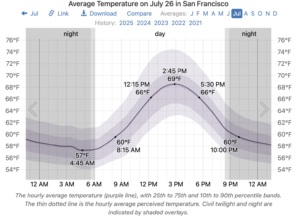
- Early morning (start time-ish): often mid 50s to low 60s °F (roughly 12 to 16 °C)
- Later morning: often low 60s to mid 60s °F (roughly 16 to 20 °C)
- Wind: can be noticeable, especially near the water
- Fog: common in many neighborhoods, especially closer to the coast
And the key detail: it usually feels cooler than what the thermometer tells you if there’s wind or fog.
So when people ask, “Will it be freezing?” the honest answer is: not usually, but it might feel like it while you’re standing still. Once you’re moving, most runners land in that sweet spot where the weather helps more than it hurts.
San Francisco Weather 101 (And Why It Confuses Everyone)
SF weather has a few quirks that surprise even seasoned travelers. There are three main points you should pay attention to so you’re not surprised on race day (because the only kind of surprise we want on race day is the “Whoa, I ran that faster than I thought I could!” kind).
1) Microclimates are real
San Francisco is small, but it doesn’t act small. Thanks to its geography, it has its own varied microclimates. The temperature can vary depending on whether you’re near the ocean, in a sheltered neighborhood, or out in an open, windy area. Fog can also plague some parts of the city, only for you to emerge into full sunshine within a few steps.
All this is to say that if someone tells you, “It was 70 in the Mission yesterday,” and someone else says, “It was 55 at Ocean Beach,” both can be true. (I personally wouldn’t want to be responsible for weather forecasts in SF!)
2) “Summer” is not summer
If you’re visiting from somewhere with a classic summer arc (hotter as you approach July and August), San Francisco’s race weekend weather is going to feel like it’s trolling you. The foggiest time of the year in the city is the calendar-correct summer!
The climate is often described as Mediterranean; however, San Francisco’s warmest stretch is often the end of summer into mid-fall, while late spring and most of summer can be cool and foggy. The city’s “true summer” comes in September and October.
3) Wind is the main character
Temperature is only half the story. Wind changes everything, especially when you’re on open roads, near the waterfront, or turning a corner into a headwind. You’re most likely to experience windy conditions when running across the Golden Gate Bridge. However, wind speeds usually pick up in the afternoon thanks to the land/sea temperature difference, and you’ll be done with your race by then.
If you’re trying to decide between a singlet and a long sleeve, the wind is usually the tiebreaker.
The Real Question: What Will It Actually Feel Like?
As we’ve already established, temperature alone doesn’t capture SF. Here are the main actors that will influence how you feel on race day.
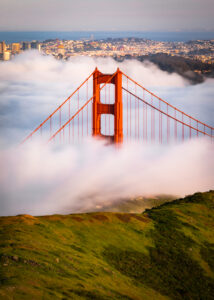
Fog
Fog can make 55°F feel like 50°F, especially if you’re standing still. It’s a damp-cool sensation, not an “it’s raining” one, more like “why do my hands feel cold.”
Wind
Wind can turn a comfortable temp into an “okay, I want my sleeves” one fast. If the forecast says 55°F and winds are up, it might feel like the high 40s in exposed areas.
Sun breaks
When the sun pops out, SF can warm up quickly. That’s when you’ll be happy you have layers to shed, or that you started cold.
What to Wear
This is where most race morning stress comes from. Here’s what you could wear on race morning based on the most common SF conditions. Pro move: wear throwaway layers in the corral (old sweatshirt, thrift store hoodie) and shed them as the day gets warmer.
If it’s 45–50°F (a colder than usual year)
- Top: long-sleeve tech OR short-sleeve shirt + arm warmers, light hoody
- Bottom: shorts for most runners; tights if you run cold
- Extras: light gloves, headband/ear warmer
If it’s 50–55°F (the classic SFM start)
- Top: short-sleeved shirt or singlet, or thin long-sleeve if you hate being cold
- Bottom: shorts
- Extras: light gloves and arm warmers if you’re unsure, then roll down or ditch
If it’s 55–62°F (a warmer SF morning)
- Top: short-sleeved shirt or singlet
- Bottom: shorts
- Extras: you can skip the gloves, but wear a hat and consider sunscreen if the sky is clear
The universal rule is to dress for mile 2, not minute 0. You want to feel slightly chilly at the start. If you feel cozy standing still, you’ll get too hot once you’re locked in.
What to bring to the start so you’re not miserable
If you only take one tip from this article, take this one: Protect your warm-up temperature. Because in SF, the waiting is what gets you. It might take some time before your wave sets off; bring a few creature comforts to stay warm.
- A throwaway layer (old hoodie, old flannel, oversized sweatshirt)
- A small trash bag or poncho if it’s foggy or breezy (sounds silly, works insanely well)
- Cheap gloves if your hands get cold easily
- A beanie/headband to protect your ears from the chill
You can either check these items at gear check or chuck them to the side as you run; discarded clothing is collected and donated after the race.
Is It Going to Rain?
San Francisco can get rain, but race weekend weather is historically dry or lightly damp conditions. And even when rain happens, it’s often more drizzle than a downpour.
If it’s wet or drizzly, wear a hat/visor to keep droplets off your face. Use anti-chafe where you normally wouldn’t (wet fabric can be rude), and consider a light shell for the start, if you can ditch it later.
What About Fog? Will It Mess With Breathing?
Fog looks dramatic, but for most runners it’s not a problem. Fog is usually just cool, moist air, and once you’re moving, you’ll most likely forget about it completely. If you’re coming from a hot climate, fog can actually feel amazing.
If you have asthma, you might experience some issues as fog can sometimes trap pollutants, and the moisture itself can exacerbate your condition. However, since our fog comes daily from the ocean and dissipates by the end of the day, it might not be as problematic as if it were sitting around for days on end.
Check the Forecast Without Spiraling

The evening before race day, check again to confirm and prep your clothes. Decide on base top choice (short sleeve vs long sleeve), whether you’re bringing gloves/arm warmers, and if you plan to gear check, carry, or discard any potential clothes you plan to take off once you warm up.
On race morning, only check the weather if you need confirmation and trust your plan. Remember that a 3–5 degree difference will not ruin your race. Overthinking and under-fueling will. So keep cool and trust your decisions.
FAQ: The Questions Runners Always Ask
“Should I wear tights?”
If you love tights, go for it. But in typical SF race-morning temps, most runners are comfortable in shorts once they’re moving.
If you run cold or you’re doing an easier effort, tights can feel great. If you’re racing hard, shorts plus optional arm warmers is a popular combo.
“Do I need a jacket?”
For the race itself, usually no. For standing around before the start, a throwaway layer is perfect.
“Will it get hot later?”
SF “hot” is usually not like other places. Late morning can warm into the low 60s, sometimes higher. If the sun comes out and you’re pushing, it can feel warm, but it’s rarely the kind of heat that melts your pace the way a humid 80°F day would.
“What if I’m traveling from somewhere warm?”
If you’re traveling for race weekend from a place with warmer weather, expect the start to feel colder than you think. Bring gloves or a throwaway layer. You can always take stuff off. You can’t magically create sleeves at the start line.
“Is it humid?”
Usually not in the way runners mean it. Fog can feel damp, but the heavy, sticky humidity that wrecks races is not the norm.
Let’s Wrap It Up
If you came here wondering whether San Francisco’s weather is going to sabotage your race weekend, you can exhale.
Based on historical patterns, SF race mornings are usually cool, comfortable, and great for running. The main thing is planning for that in-between moment when you’re standing around before the start.
Bring a throwaway layer, pick an outfit you’ve already tested, and trust that once you get moving, the weather will feel like an advantage.
See you out there!