


5 Cool Facts About the 5K to Bring to Your Next Race
Before every race, there’s always that weird little window of time where everyone is standing around near the start area, pretending they’re chill, while secretly thinking about when they last used the bathroom. Have you ever thought it would be nice to have something to say about the distance you all are about to take on? Tons of people run 5K’s, but almost nobody knows the weird, surprisingly cool stuff hiding behind the distance.
That liminal space between getting yourself to the start line still half asleep and the moment you hear “GO!” is a prime time for fun facts. Here are five 5K facts you can casually drop at packet pickup, in the start corral, or while you’re doing that awkward one-arm-in-the-air shuffle while begging your watch to find GPS.
A quick 5K refresher before we give you the facts
The distance is popular for a couple reasons. It’s approachable for beginners, so you can walk-run it and still get a satisfying finish. It’s fast for experienced runners. If you want to go fast, you can absolutely send it and be done quickly. It shows up everywhere in charity runs and community events, because it’s just long enough to feel like an “event” but not so long that people start bargaining with the possibility of never running again halfway through.
Now let’s dive into five fun facts you can use for pre-race small talk that will make you sound both fun and mildly athletic-nerdy.
Fact #1: It Has Ancient Roots in a Race Called the Dolichos
If you think the 5K is just a modern “fun run” invention, the ancient Greeks would like a word. While the modern 5,000-meter track event became standardized in the Stockholm, Sweden Olympics in 1912, the Greeks were out there doing a proto-5K long before that.
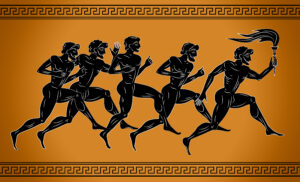
The Dolichos was basically the endurance event of its era (step aside, marathon), and while it wasn’t measured in kilometers the way 5K’s are today, it lands surprisingly close to what we’d recognize as a 5K effort.
The Dolichos was mostly run on a track in a stadium. Depending on the time period and rules, it was roughly 12 to 24 laps, which worked out to about 3 to 5 kilometers in total distance.
Just like today, it wasn’t just a “run for a while and hope for the best” kind of effort. The Dolichos demanded the same combo that makes the 5K the well-appreciated distance it is today: speed (because it’s still a race) and endurance (because it’s long enough to punish poor pacing).
Fact #2: Elite 5k Runners are Basically Flying
In a 5K, reducing ground contact time is crucial. The less time your foot spends planted, the more efficient and rapid your stride can become. It’s not about taking huge bounding strides; it’s more about being light, quick, and snappy, like when you were playing “The Ground is Lava” as a child, accidentally touched the floor, and had to quickly get back up before your friends noticed. Let’s put 5K speed into a perspective that’s actually a little absurd.
At that speed, elite runners aren’t just running. They’re spending a wild amount of time completely airborne. Their flight time (the moment both feet are off the ground) is so high that they spend more time in the air than on the ground. You might be running 5,000 meters but the runners in the front are basically flying their way through the race.
Here’s a little battle plan you can deduce from that information; in a 5K, you’re trying to run fast but sustainable. The goal is to find a rhythm that feels light and quick and doesn’t break you by mile two. Good 5K form usually looks like quicker steps, relaxed shoulders, and not fighting the ground with heavy, stompy strides.
Fact #3: Running a 5K Can “De-Age” Your Brain
Regular aerobic sports (which, yes, is running) support brain health in many ways, creating conditions that help neurogenesis (the creation of new neurons). In plain English, moving your body can help your brain stay sharper for a longer time.
One of the coolest pieces of evidence comes from research published in the Proceedings of the National Academy of Sciences, which found that regular aerobic exercise can increase the size of the hippocampus.
The hippocampus is the area of the brain heavily involved in memory and learning. It’s also one of the regions that tends to shrink as we age. On average, hippocampal volume increased by 2%, effectively reversing age-related brain shrinkage by one to two years.
So if you ever feel guilty about taking time to run, remember: you’re not just working out. You’re keeping yourself younger!
Fact #4: A certified 5K course is measured with serious precision
If a race says it’s a certified 5K course, that usually means the distance was measured to a recognized standard so it can be used for things like records and qualifying (exact rules vary by country and governing body).
In the US, for example, course certification is commonly handled through USA Track & Field (USATF) in coordination with trained measurers. One standard method used for road course measurement is a calibrated bicycle equipped with a Jones Counter.
The Association of International Marathons and Distance Races (AIMS) describes this method as part of the widely used approach and “the only means of measurement accepted by the IAAF for the accurate measurement of Road Race Courses.”
Which leads to the most runner-relevant part of this whole fact. If you weave a lot, take wide turns, or bob and weave through people like you’re in an action movie, your GPS distance will often be longer than the official course distance.
On curvy sections, run smart tangents when it’s safe. Don’t cut cones, don’t cut people off, and don’t dive across the road. Be safe and considerate of your fellow runners.
Fact #5: “3.1 miles” is a rounded number.
Everyone says a 5K is 3.1 miles, which is fair. But if you want the exact conversion (for your inner nerd, or for your outer nerd who speaks without thinking), here it is: 5 km = 3.10686 miles
Now, why does your watch sometimes show 3.11, 3.10, or 3.13 when you finish a 5K?
There are a few reasons that are all totally normal. GPS smoothing and drift happens, especially near trees, tall buildings, or big groups. You may not be running the shortest possible route/running the tangents, as we discussed in Fact #4. The course measurement might differ from runner path. The course can be perfect and your line can still be… interpretive.
Never run the 5K? You should try it!
If you’re looking to start, the Couch to 5K (C25K) program is the most famous plan in existence, specifically designed to transition the human body from sedentary to 5k-ready in just 9 weeks. And if you decide to run your first race with us, we’d be happy to have you!