
6.2 Facts About the 10k That’ll Blow Your Running Shoes Off
The 10K is one of the most popular distances out there. Whether you’re thinking about doing your first one or you’re a seasoned 10K runner, here are 6.2 cool facts about the distance! (We’re willing to bet there’s at least one or two you didn’t know, so keep on reading.)
#1: A “10K” and a “10,000m” are actually different events
This one surprises a lot of people because on paper, they look identical. 10K literally means 10,000 meters. So you’d think, same thing, right? Well, not exactly.
The 10K (written with a “K”) is usually a road or trail race. It can be run anywhere from city streets and park paths to forest roads and mountainous trails. That changes everything, even if the distance number is the same.
Road and trail courses come with hills and downhills, sharp turns, U turns, weird little chokepoints, wind, heat, humidity, rain, fog, whatever you get that day, and different surfaces, from smooth asphalt to brick to packed dirt. That’s why World Athletics keeps separate records for track, road, and mountain/trail performances.
Two runners run trails in the Rocky Mountains in Colorado
#2: The world’s largest 10K is so massive the winner can finish and shower before the last wave starts
With nearly 60,000 runners every year, the AJC Peachtree Road Race (now the Northside Hospital Peachtree Road Race) is basically the Super Bowl of 10Ks. It’s held every Fourth of July in Atlanta, Georgia, and it’s widely known as the largest fully timed running race in the United States. It regularly pulls in around 57,000 runners.
To make that even remotely work, they use a ton of start waves. Otherwise it would be a human traffic jam from start to finish. Because of that, this funny thing happens: the elites at the very front can start on time, race the full 10K, finish, grab their medal, do interviews, cool down, leave,… and yes, in some years, they can be back at a hotel showering before the final wave even crosses the starting line. That’s how spread out the starts can be when you’re dealing with a small-city worth of runners.
Bolder Boulder (Boulder, Colorado, USA): technically 10K, held on Memorial Day, famous for its stadium finish and huge crowds.
Great Manchester Run (Manchester, UK): one of Europe’s best known mass participation road races, also run as a 10K.
City2Surf (Sydney, Australia) is not a 10K (it’s 14K), but it gets mentioned in the same breath because it’s another example of a massive “everyone shows up” road race culture.
#3: Europe’s oldest continuous road race is a 10K that survived two World Wars
America’s oldest continuously run road race is the Buffalo Turkey Trot in Buffalo, New York, held annually on Thanksgiving morning since 1896. However, that’s an 8K.
If you want to find the oldest 10K, you need to travel across the Atlantic. Italy’s Palio del Drappo Verde, first run in Verona in 1208, is often called the world’s oldest still-existing 10K. However, that race took a 200-year break during the French invasion of Italy in 1798. It also wasn’t a 10K back then; it was only revived as a 10K in 2008.
“Continuous” is the important part. It has been held every year without interruption, including through the chaos of World War I and World War II. That means that while borders shifted, governments changed, cities got pulled into conflict, people still showed up and ran this race. There’s something stubbornly beautiful about that. The sport just keeps going. Or maybe humans just keep needing something normal to hold onto.
And if you’re into old school race history, there are other long running races around the world that have been going forever too, even if they’re different distances:
The Boston Marathon (USA, first run 1897): the obvious one, and it’s the world’s oldest annual marathon.
The Comrades Marathon (South Africa, first run 1921): an ultramarathon, and one of the most famous endurance races on earth.
The Falmouth Road Race (USA, first run 1973): not ancient, but a classic, and still one of the most competitive road events every summer.
#4: The “Mini Marathon” nickname has a highly retro history
There’s a reason you still occasionally hear a 10K called a “mini marathon,” and it’s not just because people like cute nicknames.
In 1972, the first ever women-only road race in the United States was held in New York City’s Central Park. It was a 10K called the Crazylegs Mini Marathon.
Which, obviously, we now know is nonsense. Women run marathons, win marathons, set world records, dominate ultras, coach, lead the sport, all of it. However, back then, the fight was still very real. Even getting women officially included in major endurance events took years of pressure, proof, and people refusing to accept the limits they were handed. Title IX was signed into law only three weeks after the first Mini.
The history of women in running is full of these moments. Small steps that were actually huge steps. And the 10K has a spot in that story.
#5: The 10,000 has a deep Olympic and World Championship history but you won’t find a 10K road race at the Olympics
The 10,000m is one of the most important events in track and field. It’s in the Olympics and in the World Championships. It’s a classic test of strength, speed, patience, stamina, and pain tolerance. It has legends, records, iconic finishes, and that “who’s going to make a move with the last 600m to go” excitement.
But the 10K road race? Not in the Olympics. Ever. Even though local 10Ks are wildly popular around the world, the Olympic program doesn’t include a road 10K. The only running road race on the Olympic stage is the marathon (26.2 miles). Separately, the Olympics also have road based race walking events.
So if an elite runner wants a major title on the roads, they usually aim for big independent road races and major city events. Road racing has its own ecosystem and history.
#6: A legendary Finn broke the “impossible” 30-minute barrier in 1939
For a long time, running 10,000 meters under 30 minutes sounded like an impossible feat, like something the human body just couldn’t do. Then on September 17, 1939, Finnish running icon Taisto Mäki broke it in Helsinki with 29:52.6.
He was one of the “Flying Finns,” and for a good reason. To run under 30 minutes for 10,000m, you have to average just under 72 seconds per 400m lap on the track, for 25 laps, or roughly 4:48 per mile pace (or, if you run in kilometers, 2:59 per kilometer), for over six miles.
To add to the record, he did it in 1939, long before the super shoes era or modern sports science.
Where is the 10K ceiling now? 10K and 10,000m records have continued to drop through the decades, especially as training, racing schedules, and technology evolved. The men’s and women’s world records today are at a level that would have looked alien to runners from Mäki’s era. This is the part I love. The 30 minute barrier used to be mythology. Now it’s possible. Most likely not for you or me, still elite, still rare, still insanely impressive. But not “impossible” anymore.
That’s kind of the whole story of distance running in one “little” moment.
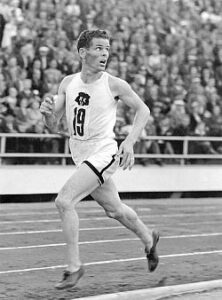
Taisto Mäki sets 10,000 meter world record. (Unknown Author\Public domain, via Wikimedia Commons.)
The “.2” bonus fact: At SFM, you can run your 10K alongside an Olympian!
If you’re the kind of person who likes a race with a little extra story behind it, the San Francisco Marathon has a fun one.
The SFM 10K is connected to Olympian Alexi Pappas, and it’s her “home race.” And yes, you can genuinely end up meeting her, seeing her around the event, and running the same 10K course alongside an actual Olympian.
For many people that’s a cool, oddly normalizing experience. Because an Olympian is still just… a runner. Pinning a bib. Warming up. Perhaps wearing vintage gear. Smiling as she crosses the finish line alongside other SFM runners.
Till the next time!
If you’re racing a 10K soon, steal one of these facts and drop it casually at packet pickup. Or in the corral. Or at brunch after.
It won’t make the last mile easier, unfortunately, but it does make the distance feel bigger than just numbers on a watch. Which, honestly, is part of why we do this in the first place.